Insights Plug

Breaking

Bitcoin

Blockchain

Finance

Recent Posts

View More

Thursday, November 20, 2025

China’s Financial Earthquake Just Struck — America’s Nightmare Is Now Reality | Prof. Jeffrey Sachs


China’s Financial Earthquake Just Struck — America’s Nightmare Is Now Reality | Prof. Jeffrey Sachs

Professor Jeffrey Sachs exposes China’s unprecedented financial moves that are dismantling America’s economic dominance. This isn’t speculation—it’s happening now. Discover how China’s strategic de-dollarization, BRICS expansion, and alternative payment systems are creating seismic shifts in global finance. Sachs reveals why the US dollar’s reign is crumbling, how China is building a parallel financial empire, and what this means for your investments and financial future. From petroyuan dominance to digital currency revolution, understand the economic earthquake reshaping world power. Essential viewing for investors, economists, and anyone concerned about the financial system’s transformation. Subscribe for critical economic insights mainstream media ignores.

#JeffreySachs #ChinaEconomy #DollarCollapse #Dedollarization #GlobalFinance #USChinaRelations #EconomicCrisis #BRICS #FinancialNews #Geopolitics #EconomicAnalysis #CurrencyWar #InvestmentStrategy #GlobalEconomy #FinancialFreedom

Jeffrey Sachs China, dollar collapse 2025, dedollarization explained, China financial system, US China economic war, BRICS currency news, global financial crisis, petroyuan rise, economic collapse prediction, dollar dominance ending, China economy analysis, financial independence tips, global economy news, currency war explained, US debt crisis, international finance news, economic geopolitics, investment strategy 2025, financial system change, China US relations, alternative currency systems, economic forecast 2025, global power shift, financial crisis warning, economic analysis today

source


from Finance – Techyrack Hub https://ift.tt/Z8kiTPA
via IFTTT

What to look for when Deere & Company (DE) reports Q4 2025 results


When Deere & Company (NYSE: DE) reports its fourth-quarter results next week, investors will be watching for updates on equipment demand and production trends. While tariff-related uncertainties and weak farmer confidence remain a drag on sales and profitability, the company maintained decent margins this year.

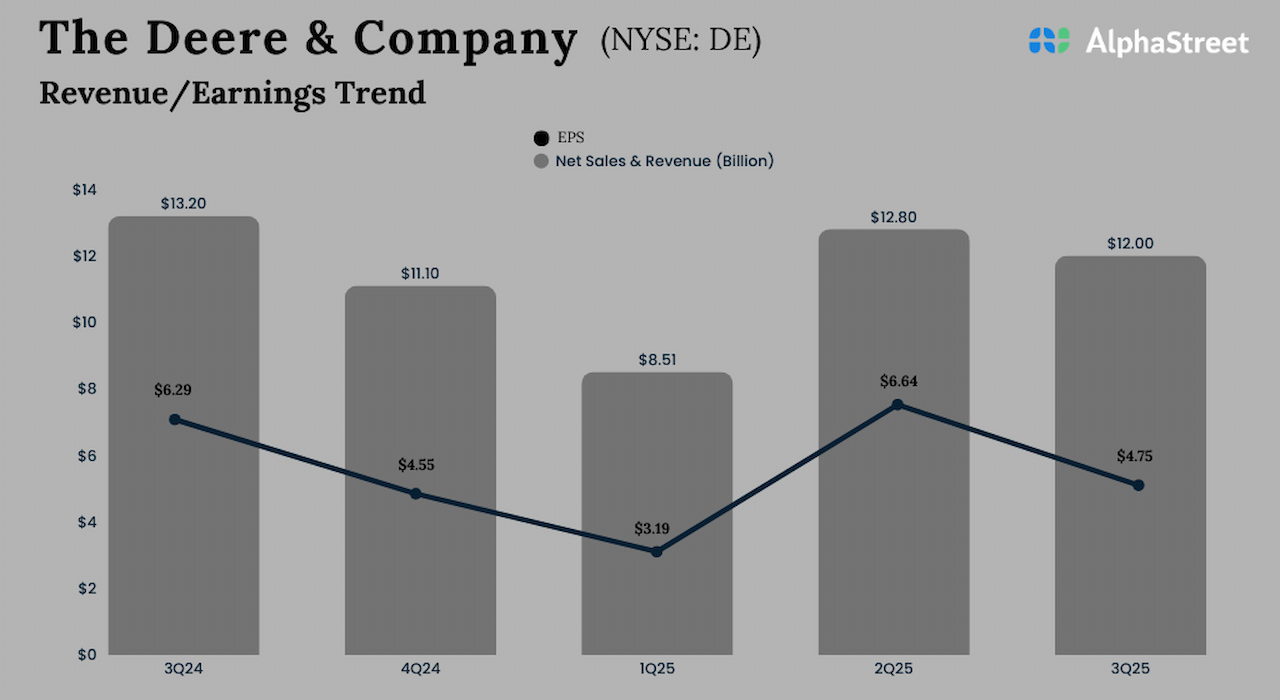
Deere & Company Q3 2025 earnings

Q4 Report on Tap

The Illinois-headquartered manufacturer of agricultural and construction equipment is set to unveil its fourth-quarter financial data on Wednesday, November 26, at 6:25 am ET. On average, analysts following the company predict earnings of $3.83 per share for the October quarter, representing a sharp decline from the year-ago quarter when it earned $4.55 per share. Meanwhile, Q4 revenues are expected to grow 5.75% year-over-year to $9.81 billion.

After hitting an all-time high in May, Deere’s stock has dropped around 10%. The average stock price for the past twelve months is $476.67. Recently, the stock rebounded and has maintained the momentum ahead of next week’s earnings.

Also Read: A snapshot of Deere & Company’s Q3 2025 earnings report

Weak Q3

In the third quarter, net income declined to $1.29 billion or $4.75 per share from $1.73 billion or $6.29 per share in the corresponding quarter of FY24. The weak bottom-line performance reflects a 9% decline in Q3 sales to $12.01 billion. Both sales and profit exceeded Wall Street’s expectations, continuing the long-term trend of outperformance. The management said it expects net income for fiscal 2025 to be in the range of $4.75 billion to $5.25 billion.

From Deere & Company’s Q3 2025 Earnings Call:

“After a slow start to the year, turf and compact utility tractor shipments in North America were better than expected, reflecting improvement in consumer confidence and favorable weather conditions. Year-over-year retail sales also increased for both tractors in Europe and Earthmoving and Forestry equipment in North America, reversing several quarters of flat or declining sales. Amidst this backdrop, Deere’s performance continues to demonstrate strong financial results.”

Strategy

As part of its efforts to empower customers, Deere is using advanced technologies such as See & Spray and Harvest Settings Automation in its products, thereby significantly reducing input costs and boosting efficiency for users. Meanwhile, the management has cautioned of a $600 million pre-tax impact from new import tariffs in the current fiscal year. It has incurred around $300 million in tariff expenses in the first nine months of the year.

On Wednesday, the stock opened at $474.36 and traded slightly higher throughout the session. DE has gained 3.6% in the past 30 days, signaling a recovery from the downturn it experienced earlier.

The post What to look for when Deere & Company (DE) reports Q4 2025 results first appeared on AlphaStreet.


from NYSE Updates – Techyrack Hub https://ift.tt/ZmOpM40
via IFTTT

October 2025 Review and Outlook


Executive Summary

  • U.S. equities hit record highs in October, led by large-cap growth stocks and the “Magnificent Seven”
  • Market breadth narrowed, with value indices and midcaps lagging but remaining in technical uptrends
  • The Federal Reserve delivered a hawkish rate cut, surprising markets and impacting rate expectations
  • Robust Q3 earnings (+10.7% YoY for S&P 500) and seasonal tailwinds support a constructive outlook for year-end
  • Seasonal headwinds now become a tailwind


U.S. equities ascended into record territory in October amid easing U.S.-China trade tensions, a hawkish Fed rate cut, robust corporate earnings, and an ongoing government shutdown.

The large-cap S&P 500 (+2.3%) and Dow Jones Industrials (+2.6%) indexes, along with the small-cap Russell 2000 (+1.8%), each recorded their respective sixth consecutive monthly gain, while the Nasdaq-100 (+4.8%) and Nasdaq Composite (+4.7%) indexes extended their streak to seven.

Growth & Value

There was a noticeable deterioration in market breadth, with an increasing number of industries consolidating prior gains. While large-cap growth (+3.6%) and small-cap growth (+3.2%) led the way, in particular the Magnificent Seven (+4.9%), large-cap value (+0.4%) and small-cap value (0.3%), they were only marginally higher. Furthermore, the S&P 500 Equal Weight and the S&P Midcap 400 indices declined 0.9% and 0.5%, respectively.

Narrowing breadth can signal increased risk for a market reversal; however, last month’s underperforming benchmarks remain within a few percentage points of all-time highs and are in technical uptrends as defined by a 50-day simple moving average (sma) being higher than their respective 200-day sma. While there remains a wide gap in relative performance, the underperformers are largely still in uptrends with positive returns.

The S&P Midcap 400 Index is the worst performing broad equity benchmark with a 5.3% total return YTD, and it is also the only broad index to not reach new 52-week highs in 2025. From a glass-half-full perspective, the benchmark has spent the prior two months in a sideways consolidation range along an expected resistance level representing the previous high set in January 2025. While it currently stands about 6% below its 52-week high, it could simply be a matter of time before it is the beneficiary of investor rotation and joins the other benchmarks in making new highs. 

S&P Midcap 400

Investor sentiment was supported by a mix of macro and sector-specific developments. A meeting between Presidents Trump and Xi produced a modest easing in trade tensions, including a reduction in U.S. tariffs on fentanyl and a one-year delay in China’s rare earth export controls. While these measures helped reduce near-term uncertainty, they were largely anticipated and did not address deeper structural issues in the bilateral relationship. The agreement was viewed as a temporary reprieve, with another meeting scheduled for April.

The technology sector continued to benefit from strong investor interest in artificial intelligence. New partnerships and deal activity helped sustain momentum leading to another robust performance by the semiconductor industry. In October, the SOX Index gained 13.5%, marking its fourth double-digit gain in six months, measuring a combined +118% total return from the April lows.

SOX Index

The Federal Reserve delivered a widely expected 25 basis-point (bp) rate cut in the final week of October and announced plans to end quantitative tightening (QT) on Decc1. Chair Jerome Powell previously telegraphed the end of QT was coming at his Oct. 14 speech at the Blockworks Digital Asset Summit (DAS) in London:

“Some signs have begun to emerge that liquidity conditions are gradually tightening, including a general firming of repo rates along with more noticeable but temporary pressures on selected dates. The Committee’s plans lay out a deliberately cautious approach to avoid the kind of money market strains experienced in September 2019.”

However, Chair Powell delivered a strongly hawkish tone during the post-FOMC press conference:

“Further reduction in the policy rate at the December meeting is not a foregone conclusion, far from it.”

The hawkish tone caught the market off guard leading to a repricing for another rate cut in December from 90% to 60%.

October was also marked by disruptions stemming from a prolonged government shutdown, which delayed the release of key employment and inflation data. September’s CPI report was eventually published and came in cooler than expected, driven by easing rent and owners’ equivalent rent figures. This reinforced the narrative of shelter-driven disinflation and offered a potential tailwind for the Fed’s inflation outlook. Political pressure intensified as SNAP benefits approached expiration on November 1, adding urgency to negotiations and raising hopes for a swift resolution.

Sector Performance

Bifurcated performance was more visible at the sector level with five of 11 groups finishing in the red in October. Semiconductors fueled the outperformance by the Technology sector (+6.2%). The previously underperforming Healthcare sector (+3.6%) had its third consecutive monthly gain. The Materials sector (-5%) was the laggard and marked its second consecutive month in the red. Financials gave back 2.8% amidst emerging “one-off” credit concerns at select banks.

S&P 500 Sectors Performance

At the small-cap level, Healthcare (+8.4%) returned its best month in 2025, driven by the resurgence in biotech stocks. The Nasdaq Biotech Index (+10%) registered its best monthly return since December 2023. Staples and Discretionary each declined 7%, driving both groups into the red YTD. Five of the 11 sectors are down 10% or more from their respective 52-week high. 

Russell 2000 Sectors Performance

Corporate earnings season is in full gear with 64% of S&P 500 companies reporting results through the end of October with 83% reporting a positive earnings surprise and 79% reporting a positive revenue surprise, according to FactSet. For Q3 2025, the blended earnings growth rate (YoY) for the S&P 500 is 10.7% better than the 7.9% expected growth rate at the beginning of the season, and on pace for a fourth consecutive double-digit gain. The forward 12-month P/E ratio for the S&P 500 is 22.9 vs. the 5-year and 10-year averages of 19.9 and 18.6, respectively. 

S&P 500 Earnings Growth: Q424-Q426

Looking Ahead

The message of the market has been quite bullish in the six months following last spring’s tariff tantrum and concerns over fading U.S. exceptionalism. Since then, the U.S. dollar (DXY) has stabilized. Long rates are closer to 4% vs. highs of 4.8% at the start of the year. The Fed eased another 50bps and will end QT on Dec. 1. Corporations are delivering double-digit earnings growth. 

Seasonality is a tailwind for equities for the remainder of 2025. Since 1970, November and December have been the top performing months for the S&P 500 with average returns of 1.8% and 1.4%, respectively. Carson Research notes the best six-month window since 1950 is November through April, which has an average return of 7%, while the worst six-month window is May through October (“Sell in May”), with an average return of 2.1%. The S&P 500 just finished this worst six-month window where it gained 22.5%. Logically, one may assume that it could steal gains from the usually bullish months that follow; however, historically that has not been the case. The previous 10 best “Sell-in-May” periods were followed by six months of gains nine of 10 times for an average return of 13.9%. 


 The information contained herein is provided for informational and educational purposes only, and nothing contained herein should be construed as investment advice, either on behalf of a particular security or an overall investment strategy. All information contained herein is obtained by Nasdaq from sources believed by Nasdaq to be accurate and reliable. However, all information is provided “as is” without warranty of any kind. ADVICE FROM SECURITIES PROFESSIONAL IS STRONGLY ADVISED.  


from Finance – Techyrack Hub https://ift.tt/dGyDVkS
via IFTTT

ARK Invest Buys Bullish, Circle and BitMine As Crypto Stocks Sink


Cathie Wood’s ARK Invest increased its exposure to crypto-related stocks on Wednesday, purchasing Bullish, Circle Internet Group and BitMine Immersion Technologies across multiple exchange-traded funds (ETFs) as crypto stocks slid deeper into the red.

According to ARK’s daily trade disclosure, the ARK Fintech Innovation ETF (ARKF) bought 48,011 shares of Bullish, while the ARK Next Generation Internet ETF (ARKW) added 92,670 shares. The ARK Innovation ETF (ARKK) made the largest move of the group, purchasing 322,917 shares of Bullish, bringing the total to $16.8 million.

ARK followed this with sizeable buys of Circle, the company behind the USDC (USDC) stablecoin. ARKF picked up 22,327 shares and ARKW snapped up 43,174, while ARKK added 150,518 shares, acquiring around $15 million worth of shares in the stablecoin issuer.

ARK also added BitMine shares. ARKF purchased 26,923 shares, and ARKW added 51,954. ARKK accumulated the single largest amount at 181,774 shares, bringing the total amount to $7.6 million.

Related: ARK Invest resumes crypto buying spree, adds BitMine and Bullish shares

Crypto stocks slide further

The buying came as crypto-exposed stocks broadly weakened as the crypto market continues to retreat from October highs.

Bullish fell 3.63% on the day to $36.39, continuing its recent slide before recovering slightly in after-hours trading. Circle closed the session down nearly 9% at $69.72. BitMine finished the day down 9.5% at $29.18, though it recovered more than 6% after hours.

BitMine share end the day down by 9.5%. Source: Google Finance

Michael Saylor-led Bitcoin treasury firm Strategy was hit even harder, dropping 9.82% on the day before recovering some losses in the after-hours.

Notably, ARK has been on a crypto buying spree over the past week amid tumbing crypto prices. On Monday, the firm purchased $10.2 million worth of BitMine shares as its stock price slid to a new record low.

Related: Cathie Wood’s ARK Invest adds BitMine shares as it offloads $30M in Tesla stock

Nvidia posts blowout earnings

As Cointelegraph reported, Nvidia delivered another blockbuster quarter on Wednesday, posting $57 billion in revenue and $31.9 billion in profit, both well above Wall Street expectations. The chip maker also issued a strong fourth-quarter revenue forecast of $65 billion, easing weeks of market anxiety over whether AI demand was starting to cool.

The upbeat earnings boosted sentiment across tech and crypto-linked equities. Nvidia shares jumped more than 5% after hours, and the momentum spilled over into Big Tech, with Apple, Microsoft, Alphabet, Amazon and Meta all posting after-hours gains.

Magazine: 2026 is the year of pragmatic privacy in crypto — Canton, Zcash and more


from Blockchain – Techyrack Hub https://ift.tt/EFK0HGk
via IFTTT

Wednesday, November 19, 2025

What to look for when Alibaba (BABA) reports Q2 FY26 results


Alibaba Group Holding Limited (NYSE: BABA) is expected to report mixed results for the second quarter, with analysts forecasting a modest increase in revenues and a decline in adjusted earnings. The core e-commerce business faces pressure from cautious consumer spending and economic uncertainties. Meanwhile, the company’s booming cloud business remains a key growth driver.

BABA had a positive start to 2025, and the stock has sustained that momentum so far. It has gained a whopping 89% since the beginning of the year, marking a strong recovery from the weakness experienced over the past few years. The stock recently hit a four-year high but reversed course in early November, trending lower ahead of next week’s earnings. Meanwhile, analysts are bullish and recommend buying the stock, citing its potential to grow up to 23% in the next twelve months.

Q2 Report Due

The China-based e-commerce behemoth is set to report second-quarter results on November 25, before the opening bell. Analysts’ consensus revenue estimate for the September quarter is RMB243.2 billion, compared to RMB236.5 billion in the corresponding period of fiscal 2025. Market watchers are looking for adjusted earnings of RMB5.78 per share for Q2. That compares to RMB15.06 per share the company earned in the year-ago quarter, which includes certain one-off gains.

From Alibaba’s Q1 2026 Earnings Call:

“China has a well-developed e-commerce infrastructure, high population density, and strong demand for service consumption, providing a solid foundation for the integration of our quick commerce business and the Taobao app. We believe this convergence will fulfill consumer needs for a one-stop consumption experience and meet merchants’ desire to serve consumers across multiple scenarios. It will enhance commerce efficiency and pave the way for an all-in-one AI assistant for consumption. Alibaba’s strategic positioning in quick Commerce has ambitions beyond competing in a single category.”

Mixed Q1

Alibaba entered fiscal 2026 on a mixed note — revenues grew 2% year-over-year to RMB247.7 billion, or $34.5 billion in the first quarter, while adjusted earnings declined by 10% to RMB14.75, or $2.06 per ADS. Revenue from the Alibaba China E-commerce Group segment was up 10% YoY, and International Digital Commerce Group revenue rose 19%. Cloud Intelligence Group revenue jumped 26% in Q1. Net income attributable to ordinary shareholders was RMB43.1 billion, or $6 billion, up 78% compared to last year. Earnings per ADS surged 82% from last year to RMB17.98, or $2.51.

The company has been actively investing in technology, particularly in AI, to drive growth across e-commerce, cloud computing, and other businesses. The e-commerce business got a major boost from the recent integration of AI into the platform, even as the broader industry is facing challenges like restrained consumer spending, increasing competition, and a complex regulatory environment.

The average price of Alibaba’s stock for the last 52 weeks is $124.23. On Tuesday, the stock opened slightly lower but soon gained momentum and was trading up 1.5% in the afternoon.


from NYSE Updates – Techyrack Hub https://ift.tt/BGK8i0M
via IFTTT

Netcapital (Nasdaq: NCPL) to Integrate Primary Issuance with Blockchain Secondary Trading – Stock Titan


Netcapital (Nasdaq: NCPL) to Integrate Primary Issuance with Blockchain Secondary Trading  Stock Titan


from Blockchain – Techyrack Hub https://ift.tt/JHi0Yl1
via IFTTT

Crypto market update #bitcoin


सारे बहन भाई “SUBSCRIBE” करके जाना

Join Our Telegram Channel –

MUDREX –
BLOFIN –

Business Queries – dishantglamathura@gmail.com
Business Queries –

Disclaimer: Cryptocurrencies are a high risk investment and may not be suitable for all members of the public and all types of investor. You should not purchase cryptocurrency unless you understand the extent of your exposure to potential loss. We are only providing information for educational purpose only and no financial advice. One should know and study properly before investing into cryptocurrencies

#Cryptocurrency #Bitcoin #dishantchaudhary #BTC #bitcoinnews #cryptocurrency #cryptocurrencies #cryptocurrencynews #Crypto #Cryptoindia #Cryptoban #CryptoNews #Bitcoin #bitcoins #bitcoinnews #crypto #binance #cryptonews #bingx

source


from Bitcoin – Techyrack Hub https://ift.tt/Q2jLvOk
via IFTTT

Comments system

[blogger][disqus][facebook]

Disqus Shortname

sigma2